Reduce costs
Lower bandwidth and storage expenses without compromising quality.
Let viewers rewind, pause, and catch up on your live streams.

DVR Recording captures your live stream and stores a rolling buffer that viewers can rewind through in real-time. Unlike post-session VOD, DVR lets audience members join late, rewind to a specific moment, and catch missed segments—all while the stream is still live. This keeps viewers engaged and reduces the frustration of missing critical moments.
Set your DVR window (typically 4–72 hours) when starting your broadcast.
Your content flows through Qencode as normal, but Qencode retains segments in a rolling buffer.
Audience members click back on the timeline to jump to any moment within the DVR window.
At stream end, optionally convert the DVR buffer to permanent VOD for future playback.
Lower bandwidth and storage expenses without compromising quality.
Automate complex processing that would take hours manually.
Handle thousands of videos with the same API call.
Simple REST API with comprehensive SDKs and documentation.
A 24-hour news network broadcasts continuously with a 48-hour DVR buffer so viewers can catch breaking stories they missed.
Increase viewer engagement by 35% as audiences no longer miss critical updates and can review breaking news context.
A live online course records lectures with a 30-day DVR buffer so students can review any part of the session.
Reduce student support tickets by 60% as learners self-serve through replay and rewind instead of asking instructors to repeat explanations.
A company broadcasts all-hands meetings with DVR enabled so remote employees across time zones can catch up asynchronously.
Eliminate scheduling conflicts and achieve 95% meeting attendance by letting employees join within 48 hours of the original broadcast.
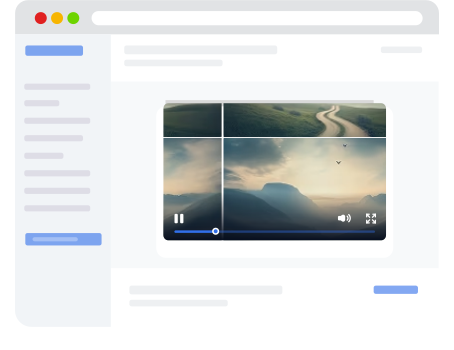
Watch a quick walkthrough showing how to configure and use DVR Recording through the Qencode dashboard and API.
| API Method | PUT /v1/live-streams/<stream_id> to update a live stream and enable or disable DVR recording. |
| Key Parameters | enabled, destination, optional stream_source, resolution, format, max_file_duration. |
| Required DVR Settings | At minimum, set dvr.enabled: 1 and provide a destination object where recorded files will be saved. |
| Destination Settings | url, key, secret, optional permissions. Currently DVR recording supports S3 destinations. |
| Stream Source | auto default, original, or transcoded. auto records the original stream when compatible and switches to transcoded if needed. |
| Recording Resolution | Applies only when stream_source is transcoded. Values: highest, lowest, 240p, 480p, 720p, 1080p, 1440p, 4k. Default is highest available transcoded resolution. |
| Output Format | mp4 default or ts. Docs recommend ts for better compatibility when recording the original ingested stream. |
| File Duration Limit | max_file_duration default is 14400 seconds, 4 hours. Maximum is 21600 seconds, 6 hours. Longer streams are split into multiple recorded files. |
| Enable / Disable Timing | DVR recording can be enabled or disabled any time, including while the stream is live. |
Enable DVR on a live stream with a buffer window and optional VOD archive on stream end.
curl -H "Authorization: Bearer $ACCESS_TOKEN"
 -X PUT https://api-live.qencode.com/v1/live-streams/$STREAM_ID
 --data-raw '{
 "dvr": {
   "enabled": 1,
   "destination": {
     "url": "s3://us-west.s3.qencode.com/bucketname/path/to/dvr_output",
     "key": "your_key",
     "secret": "your_secret",
     "permissions": "public-read"
   }
 }
}'Included with Streaming
DVR Recording is available for all Qencode users. Recording can be enabled for a live stream, and pricing follows standard live streaming usage; storage charges may apply when recordings are saved to Qencode storage.
We love creating powerful solutions that are aligned with the needs of your business.
Please send us a message if you have a question or Schedule a call for a demo to discuss your integration.
Contact us with any questions. We'd love to help.
Los Angeles, CA - (HQ)
San Francisco, CA
New York, NY